
Does the Big 12’s new court offer a competitive advantage for teams without a bye?

With only three games remaining in the Big 12 tournament, only four remain standing. Twelve teams have gone home after leaving it all on the court – but all 16 of them have slipped at least once.
The Big 12 announced in February that it would partner with ASB GlassFloor to create an incredibly immersive experience for fans at home and in-arena alike.
But now that it’s here, it seems like the Big 12 forgot about one important demographic – the players.
In a press release, the Big 12 noted that the floor had been “vetted at the highest levels,” citing its use in the 2024 NBA All-Star Game, as well as in EuroLeague professional games. It said that the court will “[enable] real-time branding, in-game activations, and data-driven visuals that seamlessly adapt across basketball and other sports without compromising performance, durability, or student-athlete safety.”
Still, the Big 12 has made changes to its court each day of the tournament, certainly an advantage to having lines set on hardwood.
On Wednesday, the 3-point and half-court lines were black, difficult to see on the gray hardwood, which forced players to look twice if shooting a 3. Thursday, the court changed those lines to white to more clearly define what would count as two points versus three. Friday, the Big 12 changed the “XII” that ran across the floor to a more polished hardwood look.

Cleaners have come out at every timeout to mop up spills from sweat, and there is certainly a more concentrated effort to clean up spots where players have hit the deck.
To its credit, no major injuries have occurred at the T-Mobile Center yet, and nearly all players responded positively to the court.
“It was just amazing to be a part of,” Houston guard Shun'teria Anumele said. “Not everybody gets to play on glass courts, and just to be a part of that was an amazing experience.”
Even coaches noted a difference and the potential to get eyes on their teams and the Big 12.
“I felt like I moved with tremendous quickness and speed,” Houston head coach Matthew Mitchell said. “I liked the court a lot.”
“It's added a lot more eyes to the Big 12, which is what we need,” Colorado head coach JR Payne said. “We need the rest of the country to see, ‘Man, they are really good. Like the Big 12 is special. It's a different league.’”
The presentation was a big selling point from the Big 12, and so far, it’s lived up to expectations as much as it can.
“The whole court being lit up in BYU blue and [the players] names being the whole court, I thought that was a cool thing I’ve seen as far as pregame introductions,” BYU head coach Lee Cummard said.

“Yeah, it's like playing on a big iPad,” CU freshman forward Logyn Greer said. “So it's cool.”
Some players were indifferent about the differences between the glass court and a hardwood floor.
“Playing with my team, I honestly don't care where we play,” Arizona State sophomore forward Heloisa Carrera said.
“It's a little bit [of a] different feel, but it's basketball,” Kansas State junior guard Tayrn Sides said.
While most players described the court as “cool,” “slippery” was another word often used by players who played during the first two days.
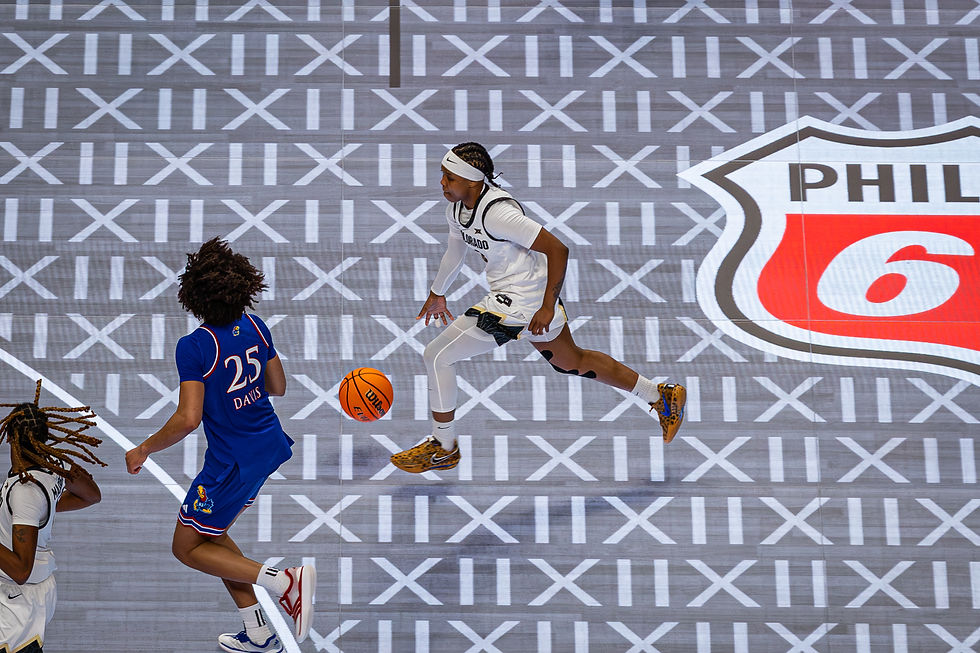
“Personally, I don't like it,” Buffs junior guard Desiree Wooten said. “It was really slippery.”
“I think it’s a cool idea,” Kansas senior guard Elle Evans said. “I will say it was a little slip in some areas, but you kinda got used to it.”
“I was sliding a little bit,” BYU sophomore guard Brinley Cannon said.
The slickness has impacted plays and shifted games. In a quarterfinals matchup between No. 4-seed Oklahoma State and No. 12-seed Kansas State, Cowgirls guard Jadyn Wooten slipped on the court during a fast break.
“That was a momentum play that could have gone our way that did not,” Oklahoma State head coach Jacie Hoyt said. “Just those little things that take some time to adjust to.”
Oklahoma State lost to the Wildcats by one point.
Most players have noted a difference in the court compared to a normal hardwood floor.
“I think it feels different,” Houston senior guard TK Pitts said after the Cougars’ 76-66 loss to BYU on the first day of the tournament.
[It’s] nice to see the Big 12 try and bring some uniqueness, but at the same time, it would be nice to play on a [regular] court,” Oklahoma State junior guard Amari Whiting said.
So does playing on a new court at the biggest stage offer a competitive advantage?
Since major conference realignment in 2024, women’s basketball conference tournaments have seen their fair share of Cinderella team.
Last year, the Big 12 saw two teams play in the first round make it to day three of the tournament, while the other three Power Four conferences saw three combined.
This year, among the Big Ten, ACC and SEC, teams with a bye are a combined 13-7, and no team that played on the first day of their respective tournament made the semifinals. The Big 12’s teams who had a bye are 4-5 this year. Kansas State, the conference’s No. 12-seed, earned a spot in the semifinals after winning three games in three days with a chance to make it more.
While it is an admittedly small sample size, is it just parity in the Big 12, or are there other forces at play? The Big 12 hasn’t had a clear-cut top team, and anyone can be competitive with anyone on any given night.
Most players noted that adjusting physically and getting used to the feel of the court only took about a half.
“It definitely is a little bit of a different [feeling] you kind of have to get used to,” Cannon said. “I think [in] the second half we got more used to it.”
“We’re in rhythm,” KSU junior forward Nastja Claessens said. “We’ve been here three days [on the court], so I think that also plays a little bit to our advantage.”
Still, without the tape on a hardwood floor to outline the 3-point line, baseline, boundaries or even free throw line, players have to be more spatially aware.
“It took a little getting used to, like with some of the lines, stuff like that,” ASU senior guard Marley Washenitz said.

Some players noted mental adjustments as they continue to battle injuries from a long, grueling season.
“I think it made us a bit timid,” KU junior guard S’Mya Nichols said. “We all have previous injuries that we're still working with, so it's kind of like you're in your head mentally about it because it's not the same as a regular court.”
“I think probably for my knees, personally, it felt a little bit better, as opposed to the hardwood,” Wachenitz said. “But when it comes to falling, usually I don't even feel half of what happens.”
Getting jitters out and conditioning bodies on a slightly different court might actually prove to have an impact. At the highest level and with margins so thin, any advantage teams can get, they’ll take.
Glass or hardwood, the teams have to play in the same conditions either way.


Comments