
Preview: Buffaloes enter conference play in competitive Big 12

Updated: Jan 3

Article by Matt Spivack & Liam Howard
The Colorado Buffaloes enter their second stretch of conference play as members of the Big 12 in 2026. They are set to face one of the deepest conferences in men’s basketball this season, so here’s an outlook on how they fare.
Last season, Colorado struggled mightily in its conference slate. The Buffaloes finished with a 3-17 record in conference play with victories over the TCU Horned Frogs, Baylor Bears and UCF Knights.
However, Colorado found surprising success in the Big 12 Championship tournament. Despite being the No. 16-seed, the Buffs won their first two games before falling to the Houston Cougars in the quarterfinals. It was the furthest any No. 16-seed had advanced in a conference tournament since the Tennessee Volunteers did so in the 1931 SoCon Championship tournament.
Games Colorado should win
Colorado has shown improvement from last season through non-conference play. With that improvement, the Buffaloes have some conference games they should expect to win.

CU hosts the Utah Utes in its second game of conference play on Jan. 7.
While these two teams are largely even, the home-court advantage of the CU Events Center will give the Buffaloes the advantage.
Utah finished its non-conference schedule 8-5 with losses to the Cal Poly Mustangs, Grand Canyon Lopes and Washington Huskies, among others. Colorado defeated that same Washington team in the Acrisure Holiday Classic Championship.
The inconsistency and Big-12-worst defense of the Utes will be a major disadvantage when they come to Boulder, and the Buffs should capitalize.
One week after that Utah matchup, the Cincinnati Bearcats come to town.
Cincy also went 8-5 in non-conference play with losses to Eastern Michigan, Xavier, Georgia and others.
Colorado’s scoring outmatches the Bearcats. Cincinnati’s leading scorer, forward Baba Miller, averages just 13.6 points per game. He is the only player on the team averaging over 13 points, while Colorado has three players above that mark.
Colorado’s offense, alongside the home-court advantage, should give the Buffs a confident win over the Bearcats.
On Feb. 1, the Buffaloes will kick off the month with a home game against the TCU Horned Frogs.
While TCU has had some major high points this season, like upsetting the then No. 10 Florida Gators, it has also had moments of severe disappointment. Namely, the Horned Frogs began their season with a loss to the New Orleans Privateers of the Southland Conference, who have won just three games since.
TCU ranks 11th in the Big 12 in points, 15th in three-point percentage and third in steals allowed per game.
Against a dangerous offensive team like Colorado in the elevation, this is a game TCU will be hard-pressed to win.
The Buffaloes will play their second game against the Arizona State Sun Devils on Feb. 7 at the CU Events Center. While their first contest in Tempe could go either way, the home-court advantage will once again give Colorado the edge.
ASU went 9-4 in non-conference play with back-to-back losses to the UCLA Bruins and Oregon State Beavers at the end of that stretch.
Guard Maurice Odum leads a solid scoring offense, but the Sun Devils have struggled in the rebounding category. They rank last in the Big 12 in rebounds per game with an average of just 33. While Colorado doesn’t excel in that category either, Arizona State’s clear struggles on the glass, paired with the altitude fatigue, should tip the scales in favor of the Buffs.
The final game Colorado fans can rest easy about is the Buffaloes’ home matchup against the Kansas State Wildcats on Feb. 25. KSU also finished 9-4 in non-conference play, with all four losses coming in consecutive games from Nov. 21 to Dec. 6.
While Kansas State features an offense that averages 88.5 points per game led by star guard P.J. Haggerty, its defense ranks among the worst in the Big 12. The Wildcats allow an average of 77.6 points per game, and when facing a lethal scoring team like Colorado in such a hostile environment, that will be immensely difficult to overcome.
Games Colorado would need an upset
For Colorado, a win against one of the top teams in the conference, highlighted by the Houston Cougars, Texas Tech Red Raiders, Arizona Wildcats, Iowa State Cyclones, Kansas Jayhawks and BYU Cougars, would surely be considered an upset.

A Buffs win in any of these games would give the team enormous amounts of confidence and could spark a run. Last year, Colorado beat the defending National Champion UConn Huskies in the Maui Invitational, so anything is possible.
Unfortunately for the Buffaloes, Texas Tech is one of the two teams that appear twice on their schedule. Although both squads are heading into conference play with a 10-3 record, the Red Raiders’ losses have all come to ranked teams, including a one-point loss to the No. 6 Duke Blue Devils and a seven-point loss to the No. 18 Arkansas Razorbacks.
On the contrary, all three of the Buffaloes’ losses were to unranked opponents, explaining why the Red Raiders are ranked No. 15 and the Buffs are unranked. Texas Tech should be heavily favored in both matchups, regardless of the location (Jan. 10 @ CU, Feb. 11 @ Texas Tech).
On January 20, the No. 17 Kansas Jayhawks will play in Boulder.
Kansas has won 21 of the last 22 matchups against Colorado, dating back to 2003. The Buffs’ only win came in 2013, when the black and gold defeated the Jayhawks by three points at home.
Last year, the Buffs lost by seven at home to a struggling Kansas team, leaving concern for this year’s matchup, considering the bounce back from Bill Self’s team.
Arguably the toughest game on Colorado’s schedule features a trip to Ames, Iowa, to take on the No. 3 Iowa State Cyclones.
Last year, these squads matched up three times, with the Cyclones sweeping the season series 3-0. This year, the only meeting between these teams is scheduled for January 29. The Cyclones head into conference play undefeated (13-0), including a signature 23-point win over No. 5 Purdue Boilermakers.
The Buffs’ big men will be challenged by outstanding forwards Joshua Jefferson and Milan Momcilovic, both averaging 18 points per game on 55 percent from the field. Colorado has the size to defend in the paint; the question is, will the team stick to the gameplan and give maximum effort on the defensive side of the floor?
On Valentine’s Day, the Buffaloes will take on the No. 10 BYU Cougars in Provo, Utah.
Freshman forward AJ Dybansta is a force to be reckoned with, leading his team in scoring with over 23 points per game. The forward has the second-best odds to win the Naismith College Player of the Year (+300 Fanduel). For the Buffs to have a chance in this game, their paint defense has to be stout.
Colorado will travel to face last year’s National Championship runner-up, the No. 8 Houston Cougars, on February 28. Houston’s lone loss of the season was to the No. 19 Tennessee Volunteers by one score. The Cougars’ experience and coaching outmatch the Buffs’, which should make Colorado heavy underdogs in this game.
The Buffs’ last scheduled game of the year brings the current No. 1 Arizona Wildcats into Boulder on March 7. This game could have implications for Arizona’s ability to be the regular-season Big 12 Champ. For Colorado, it is highly unlikely the Buffs will be competing for the Big 12 Championship; moreover, the squad could still be looking for its first win against a ranked opponent.
Toss-up games
With the overall depth of the Big 12, Colorado faces several likely nailbiters in its Big 12 schedule. This includes teams that it should have no problem with when playing in Boulder, but with a road environment factored in for the Buffs, those second meetings are much tougher.
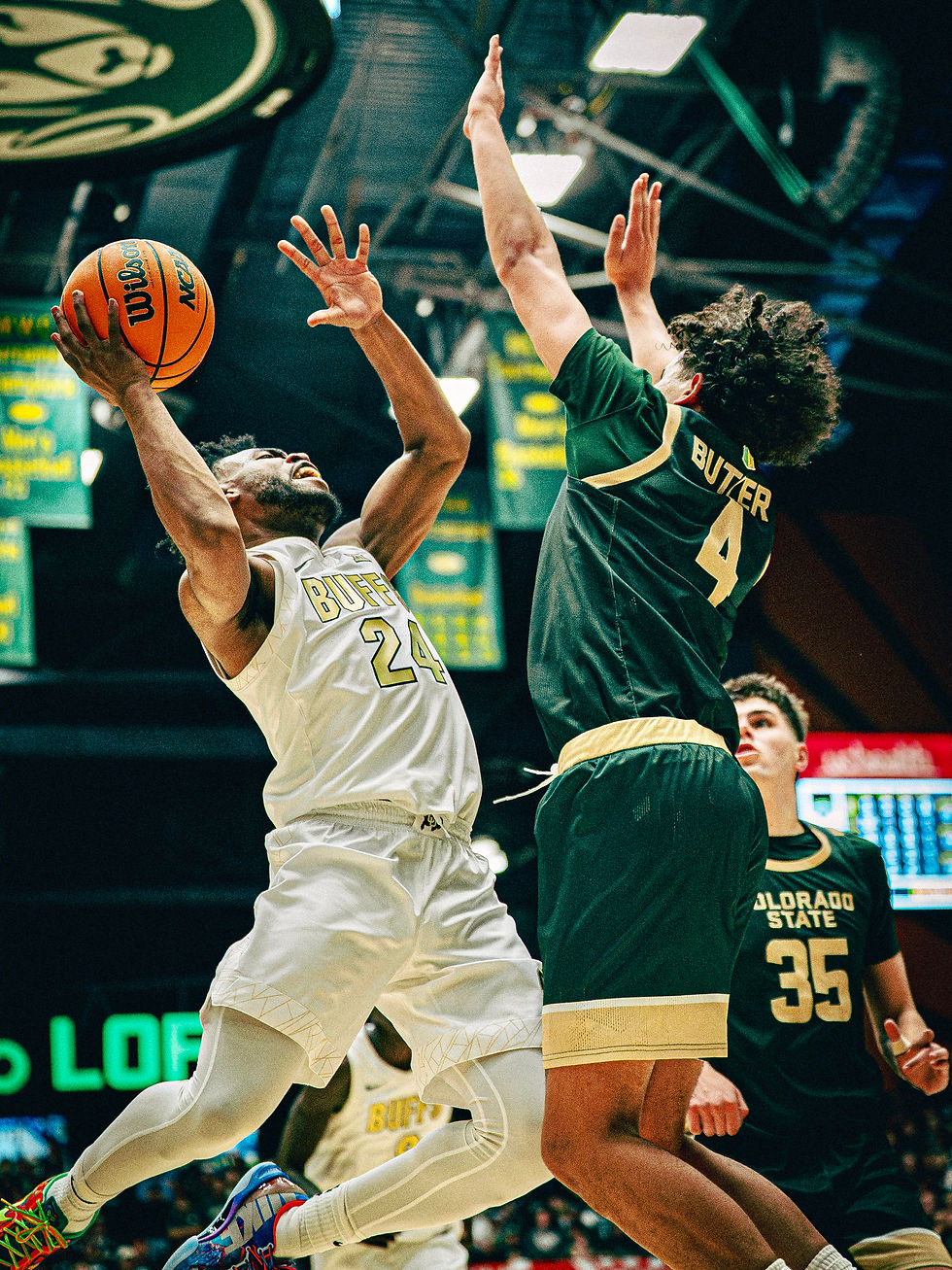
Colorado’s first game of Big 12 play will take place in Tempe, Arizona, against the Arizona State Sun Devils on Jan. 3.
This is a team the Buffaloes should have no problem with at home, but fresh off an embarrassing loss to Northern Colorado and a previous loss in Arizona to the Stanford Cardinal, the Buffs may struggle to escape Desert Financial Arena with a victory.
Next is another tough road test as the Buffaloes travel to Morgantown, West Virginia, to face the West Virginia Mountaineers on Jan. 17.
This will be Colorado’s only regular-season matchup against the Mountaineers, and they currently stand as very even opponents.
While the Mountaineers do have one more loss than the Buffaloes, all four defeats came at the hands of Power Five programs.
The game should be high-scoring, as both teams’ offensively-skilled backcourts will do battle.
The Mountaineers are led by guards Honor Huff and Chance Moore, who average 17.5 and 12.3 points per game, respectively. Their matchup with Isaiah Johnson and Barrington Hargress could decide the game.
But what may pose a bigger challenge to the Buffs is West Virginia’s elite defense. WVU allows just 60.2 points per game on average. They rank second in the Big 12 in that category, only trailing the No. 8 Houston Cougars.
Additionally, WVU Coliseum is known for a rowdy atmosphere that creates a tough environment for any visitor.
A matchup Colorado will have a tough time with, despite not playing in a road atmosphere, though, is its game against the UCF Knights on Jan. 24.
UCF has been off to a red-hot start in non-conference play, boasting an 11-1 record. Despite not facing the most stout competition, the Knights have handled their business when they should, something Colorado has struggled with at times.
The Buffs will need to step up their game in the rebounding category, as UCF averages 40.8 rebounds per game. They rank third in the Big 12 in that category, while the Buffaloes rank 13th with just 36.5 on average.
As much as a packed CU Events Center can affect shooting and communication, dominant rebounding is often unflappable, creating a major hurdle for the Buffs to climb.
Colorado’s game against the Baylor Bears on Feb. 4 in Waco, Texas, also presents a toss-up game.
Similar to UCF, Baylor handled its business against a weak non-conference slate and finished the stretch at 10-2.
The Bears compiled some scoring and rebounding masterclasses in that time, as they rank atop the Big 12 in points and second in rebounds per game.
This will be another intriguing backcourt matchup to watch as Johnson and Hargress will go toe-to-toe with Cameron Carr and Tounde Yessoufou, who average 21.3 and 19.3 points per game, respectively.
However, if Colorado can win that positional matchup, that game will become very winnable.
Another Colorado home game that stands as a toss-up is the Buffs’ matchup against the Oklahoma State Cowboys on Feb. 21.
The Cowboys performed well in non-conference play, finishing with an impressive 12-1 record and the second-most points per game in the Big 12.
Like many other dangerous Big 12 teams, they are led by a star duo in the backcourt. Guards Anthony Roy and Vyctorious Miller average 17.3 and 15.9 points per game, respectively.
But despite how full Colorado’s hands will be defensively, it stands a fair chance to fight offensive fire with some of its own to come out victorious. The Buffaloes average fewer points per game, but are more efficient from the field, three-point range and the free-throw line.
If Colorado can create looks more abundantly than the Cowboys, they could out-score the Cowboys’ stellar offense.
Finally, Colorado will play its second game against the Utah Utes on March 3. The key difference: home-court advantage will be in favor of the Utes.
Utah will have already seen the Buffs once, and in the case of it losing that first matchup, it will be able to adjust to what went wrong in that first contest. That, paired with a rocking crowd at Jon M. Huntsman Center, will make this anyone's game.
Big 12 awards outlook
With conference play right around the corner, the race for Big 12 Player of the Year and many other awards is just beginning. Nonetheless, the guys who dominated during non-conference play are frontrunners for certain awards.

Two players stand out in the Big 12 Player of the Year race: BYU’s Dybansta and Texas Tech’s JT Toppin.
Toppin is the reigning Big 12 Player of the Year and statistically is having a better season than last year. He is averaging more points, rebounds, assists, steals and blocks than last season.
Dybansta is playing in his first collegiate season and has already garnered national attention. The 6-foot-8 freshman has dominated in non-conference play, averaging 23 points per game (2nd in NCAA), seven rebounds and four assists on 59 percent from the field. The head-to-head match-ups between these squads could very well decide the winner, especially the meeting on March 7 to end conference play.
Houston forward Joseph Tugler should be the frontrunner for Defensive Player of the Year, considering he won the award last year. In 13 games played this season, the junior is putting up similar stats to his sophomore campaign. This year, Tugler is averaging eight points, five rebounds, two steals and two blocks per game. With Houston competing for the Big 12 Championship and the NCAA Championship, Tugler could repeat as the conference's top defender.
The Big 12 Freshman of the Year should come down to two players, Dybansta and Kansas guard Darryn Peterson.
With Dybansta in the running for Player of the Year, it should not be a surprise that he is also competing for the best freshman in the conference. Dybansta would join the elite company of Kevin Durant, Michael Beasley, Marcus Smart and Cade Cunningham if he took home both awards in 2026.
For Peterson, winning the award would be an uphill battle, due to an injury that has sidelined him for nine of the team’s 13 games. Despite missing a majority of the non-conference play, the guard hopes to return to the court for the beginning of Big 12 play. In his four games this season, Peterson has averaged 19 points, four rebounds, three assists and two stocks (steals + blocks) on 53 percent from the field. Peterson would have to get healthy and lead Kansas to a great season to steal the award from Dybansta.
The coach of the year will likely come from the team that wins the Big 12 championship, leaving Arizona’s Tommy Lloyd, Iowa State’s T.J. Otzelberger, BYU’s Kevin Young, Houston’s Kelvin Sampson, Kansas’ Bill Self and Texas Tech’s Grant McCasland in the running.
Sampson won the award last year, with his Cougars taking home both the regular season and Big 12 tournament championships. Heading into conference play, this award is up for grabs and will be dictated by how many of these squads match up against each other.
For the Buffaloes, a repeat season of last year would not yield the players or coaches any conference recognition. Colorado would have to put together a competitive season and finish at or above .500 for a Buff to win an award.
With that being said, Johnson continues to ball out night in and night out, making a case for why he should be in the running for Big 12 Freshman of the Year. Johnson leads the Buffs in points per game (15.6) and has the ninth-best offensive rating in the NCAA (146.4, sportsreference.com)
For Colorado head coach Tad Boyle to compete for coach of the year, Colorado would have to win around 12 out of their 18 conference games and finish near the top of the standings. With seven ranked opponents on the schedule (four inside the top 10), Colorado will have plenty of chances to upset some of the best teams in the country.


Comments