
How Tad Boyle gave up his earnings to pursue something bigger
Updated: May 1
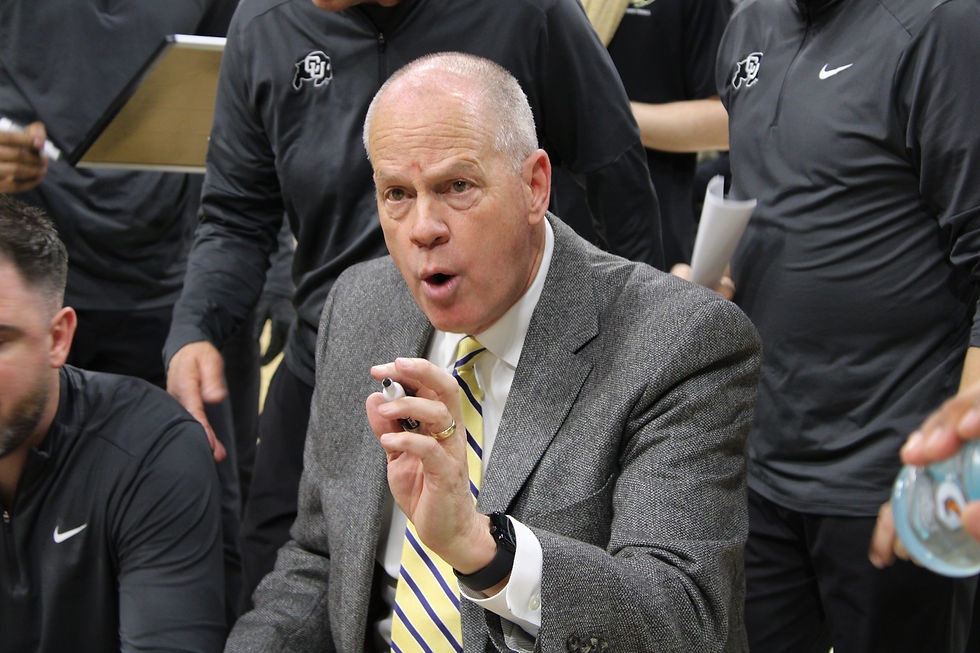
Approaching McCaslin Boulevard and South Boulder Road, the sunrise glared into Tad Boyle’s eyes. As Boyle’s car inched into the intersection, another car sped through a red light and crushed the front of his car, knocking Boyle unconscious.
The accident didn't just shake him — it redirected his life.
“I thought to myself, you know, if I don't go into coaching now, maybe I'll never get the chance to do it again,” Boyle said.
Now in his 16th season coaching the Colorado Buffaloes men's basketball team, Boyle, 63, has built one of the more quietly remarkable careers in college basketball — trading a six-figure salary as an investment advisor for a $16,000-a-year coaching stipend, and eventually arriving at approximately $2.5 million a season.
Growing up in Greeley, Colorado, Boyle said he quickly fell in love with basketball. He often followed his older brother to the gym to practice.
“The bug kind of caught me,” Boyle said. “I just committed myself to it, because it was a passion of mine.”
Boyle played as a guard on the basketball team at the University of Kansas and acquired a degree in business finance. He went on to work in northern Colorado as an investment advisor, making six figures a year.
While working as an investment advisor, Boyle spent six years coaching high school basketball on the side.
A college teammate, Mark Turgeon, then offered Boyle a restricted earnings position at the University of Oregon, a job that came with a significant pay cut.
At the time, the NCAA enforced a rule that stated certain Division I coaches could only make $16,000 a year.
“I gave up a lot of money and a good career, and I jumped into the college coaching ranks,” Boyle said.
Boyle said he was the happiest he’d ever been, despite making $16,000. His wife helped carry the weight of financial burdens through her job at an advertising agency, and together, they made ends meet.
After being an assistant coach for 12 years, Boyle got his first head coaching job at the University of Northern Colorado in 2006.
Boyle’s daughter, Claire, remembers a time when her dad’s future millions were still just a goal.
“My dad bought a house in Greeley, and he was like, 'This is the biggest house we'll ever own,’” Claire said. “He wasn’t really expecting to land where he is now.”
Boyle was eventually hired as CU’s head basketball coach in 2010 — growing up in northern Colorado, this had always been a dream job.

After moving to Boulder, Claire and her siblings were shocked at how different their lives would become.
“It was this whole different world,” she said. “Moving into a house like we did, it felt like I was in a dream.”
In his second year at CU, Boyle led his team to win the Pac-12 Championship with four wins in four days. This win alone granted Boyle a bonus of about $200,000 — already matching what he had made as an investment advisor in the ‘90s.
Now, 16 years into coaching at CU, Boyle is making a little over $2.5 million per season.
Although his salary has increased, his family and friends say that he remains one of the most humble guys they know, especially compared to other college coaches.
Boyle’s eldest son, Jack, says that he appreciates his dad’s modesty as both a coach and a parent.
“His success has benefited himself and us as a family. He’s always been a very humble and down-to-earth guy,” he said. “He’s the antithesis of Coach Prime [Deion Sanders] in terms of lifestyle."
In Boyle’s 32-year-long coaching career, his salary has increased by over $2 million. But it’s never been about the money.
“It's the relationships that you build while you're there,” Boyle said. “It's not necessarily the win against Oklahoma or the championship you won, it's more about the times you had and the memories you created.”


Comments