
Inside the Big 12’s seeding race: survival, variance and the March margin

The latest AP poll reshuffled the national picture, but the margin is paper-thin in the Big 12.
With multiple teams ranked in the top four seeds of the NCAA tournament, and several star players out with season-ending injuries, the conference’s hierarchy feels both defined and fragile. As March approaches, the strength of the resume will determine positioning.
At the top of the standings, three teams have separated themselves from the rest of the conference.
Tier 1: The Conference Contenders
Arizona Wildcats

The Arizona Wildcats sit atop the Big 12 at 29-2 (16-2 Big 12) are the second-best team in the nation, garnering five first-place votes for a total of 1,439 points, only under the Duke Blue Devils with 56 first-place votes. Arizona also secured the No. 1 seed in the Big 12 tournament, earning a double-bye to the quarterfinals.
The Wildcats are projected to be the No. 1 seed in the West region of the NCAA tournament. They carry a 14-2 Quad 1 record, taking down teams No. 2 Houston, No. 3 Florida, No. 3 Connecticut, No. 6 Iowa State and No. 23 BYU. They are also undefeated through Quads 2, 3 and 4. The two teams to beat the Wildcats were the No. 9 Kansas Jayhawks in Allen Fieldhouse and the No. 16 Texas Tech Red Raiders, who won in McKale Center.
Three outstanding freshmen have led the Wildcats: guard Brayden Burries, leading the team in scoring with 16 points and 5.0 boards; forward Koa Peat, averaging 13.8 points and 5.3 rebounds; and forward Ivan Kharchenkov, averaging 9.8 points and 1.5 steals.
The Wildcats also had multiple returners like guards Jaden Bradley and Anthony Dell’orso, along with forward Tobe Awaka and center Motiejus Krivas.
Bradley, being the veteran leader of the team, leads the Wildcat offense with 4.6 assists and 1.6 steals. Dell’Orso, a spark off the bench for coach Tommy Lloyd averaging 8.7 points along with 2.1 assists. Awaka is a force in the interior, hauling down 3.7 offensive rebounds first in the Big 12 and getting 9.5 rebounds per game. Krivas, hailing from Lithuania, is a force to be reckoned with around the basket, averaging 1.8 blocks per game.
Arizona’s offense thrives on rhythm and spacing, shooting 50.2% from the field and 35.3% from the 3-point line. In their two losses, their shooting percentage beyond the arc dropped significantly, inherently compressing driving lanes and slowing offensive flow. As March approaches, that shooting variance becomes the one variable the Wildcats cannot fully control.
Behind Arizona, the Big 12 becomes a gauntlet. Iowa State, Houston, Texas Tech, Kansas and BYU have spent the season trading Quad 1 wins and resume-damaging losses, creating one of the nation’s most dangerous conferences.
Houston Cougars

Right after the Wildcats are the Houston Cougars, led by legendary coach Kelvin Sampson. They are ranked No. 5 in the nation at 1,241 points, with a 26-5 (14-4 Big 12) record. Houston enters the Big 12 tournament as the No. 2, earning a double-bye into the quarterfinals.
They are currently projected to be the second seed in the Midwest Region. They are 7-5 in Quad 1 with key wins over No. 14 Arkansas, No. 14 Texas Tech, and No. 16 BYU. The tough losses came against No. 4 Arizona, No. 6 Iowa State, No. 12 Texas Tech, and No. 14 Kansas. Along with Arizona and Iowa State, the Cougars also post an untouched Quad 2, 3 and 4 record.
The Cougars are one of the most balanced teams in the league, starting two freshmen, something unheard of on a team coached by Sampson, and three seasoned vets. Freshman guard Kingston Flemings leads the team in three categories: points (16.5 ), assists (5.4), and steals (1.5). Returning guards Milos Uzan and Emmanuel Sharp combine for 27.3 points and 6 assists a night.
While Houston’s perimeter trio generates the scoring, the interior is protected by Joseph Tugler, of the conference’s premier defensive center. The reigning Big 12 defensive player of the year protects the rim and disrupts passing lanes, embodying the physical defensive identity that has defined Kelvin Sampson’s program.
Unlike most, if not all, teams in the Big 12, Houston’s play style doesn't exhibit an obvious flaw. With multiple go-to scorers, their postseason will hinge less on matchups and more on execution.
Texas Tech Red Raiders

If Houston thrives on control and Iowa State on disruption, Texas Tech has carved its identity through balance and physical resilience.
The Red Raiders are ranked 16th in the AP Poll, with 554 points, and hold a 22-9 (12-6 Big 12) record. However, the season took a turn when a season-ending ACL tear to JT Toppin reshaped their tournament outlook. The Red Raiders secured the No. 4 seed in the Big 12 tournament and will start play in the quarterfinals.
They are projected to be a No. 4 seed in the South Region. They are .500 in Quad 1, going 7-7 with statement wins over No. 1 Arizona, No. 3 Duke, No. 4 Iowa State, No. 6 Houston, and No. 11 BYU. The defeats came to No. 1 Purdue, No. 7 Houston, No. 11 Kansas, No. 14 Illinois and No. 17 Arkansas, with a bad loss to unranked Arizona State and TCU.
Before Toppin tore his ACL, he led the Red Raiders in four of five categories, averaging 21.8 points, 10.8 rebounds, 1.4 steals and 1.7 blocks. Now, with TTU’s star out, guard Christian Anderson and forward Donovan Atwell have combined to score 32.8 points per game, while Anderson has been the engine with 7.8 assists.
In the wake of Toppin’s injury, one player has stepped up; forward Lejuan Watts has been taking some of the scoring burden on his shoulders, averaging 11.5 points and 6 rebounds.
The Red Raiders proved they could go head-to-head with the top teams in the conference, but Toppin's injury changed their ceiling. Without his two-way presence, it forces greater responsibility on the perimeter when every shot matters.
Tier 2: Dangerous Tournament Teams
Iowa State Cyclones

The Iowa State Cyclones enter as the second-best team in the Big 12 (25-6, 12-6 Big 12), currently No. 7 in the AP Poll at 1,137 points. The Cyclones earned the No. 5 seed in the Big 12 tournament, awaiting the winner of Arizona State and Baylor.
The Cyclones are currently projected to be the third seed in the East region. They hold a 6-6 Quad 1 record with wins over No. 1 Purdue, No. 2 Houston, No. 9 Kansas, and No. 14 St. John’s. They fell to No. 2 Arizona, No. 16 Texas Tech, No. 23 BYU, TCU and Cincinnati, who are unranked. Like Arizona, they also carry an unblemished Quad 2, 3, and 4 record.
Iowa State is led in scoring by forward Milan Momcilovic, one of the best shooters in the nation, sitting at 114 made 3s, shooting 50% beyond the arc, averaging 17 points and 3.1 rebounds per game, while the backcourt veteran Tamin Lipsey averages 13.3 points, 5 assists, and 2 steals.
Few players in the Big 12 impact the game in as many ways as forward Joshua Jefferson, whose rare point forward stat line (16.6 points, 7.4 rebounds, and 5 assists) places him as the Cyclones’ best player and the All-American conversation.
The Cyclones have been nearly untouchable in Ames. On the road, they’ve been far more vulnerable, with five of their six Quad 1 losses coming on the road. It introduces a variable that head coach TJ Otzelberger will have to account for: can their defense travel when the crowd disappears?
Kansas Jayhawks
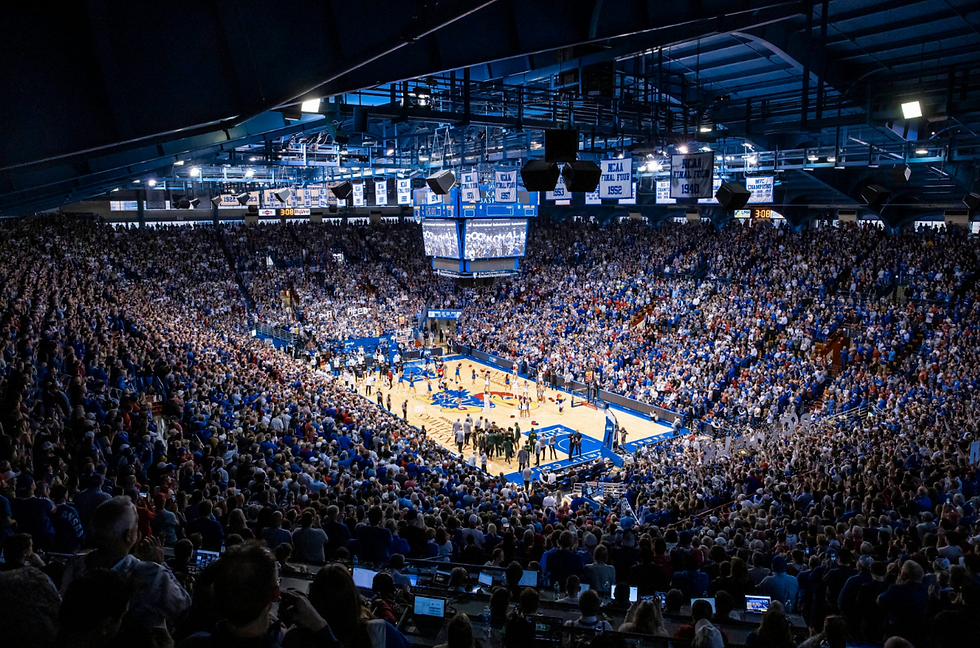
And then there’s the Kansas Jayhawks, ranked 14th in the latest AP Poll, with a record of 22-9 (12-6 in the Big 12). They are the conference’s lone blue blood, carrying both expectation and inconsistency into March. The Jayhawks enter the Big 12 tournament as the No. 3 seed and will start in the quarterfinals.
The biggest storyline has been the health of freshman phenom Darryn Peterson. The standout guard averages 19.9 points and 4.2 rebounds but has only appeared in 20 of the Jayhawks’ 31 games. Despite his absence, Kansas has managed to remain competitive in the Big 12 thanks to the emergence of sophomore center Flory Bidunga.
Bidunga averages 13.8 points, 9 rebounds and 2.7 blocks, which is third in the nation, protecting the rim and controlling the glass while helping Kansas maintain its physical identity.
Along with Bidunga is senior guard Melvin Council Jr., an all-around player averaging 13.4 points, 4.9 rebounds, and 5.2 assists per game while also being a ball hawk with 1.1 steals.
They are projected to be a No. 3 seed in the West region. They are also 7-7 in Quad 1 with wins against No. 1 Arizona, No. 2 Iowa State, No. 5 Houston, No. 13 BYU, No. 13 Texas Tech, and No. 17 Tennessee. With losses against No. 2 Arizona, No. 5 Iowa State, No. 5 UConn, No. 5 Duke, No. 5 North Carolina, and 2 losses to unranked Arizona State and Cincinnati.
Beneath the conference’s contenders sits a tightly packed middle tier. Five teams: TCU, UCF, Cincinnati, BYU, and West Virginia, are only separated by a handful of games, creating one of the most volatile races in the conference standings.
Tier 3: The Middle Tier Battle
BYU Cougars

If the top of the Big 12 is defined by separation, the middle is defined by fluctuation, and BYU has lived on that edge all season. The Cougars fell to the No. 10 seed in the Big 12 tournament, set to take on the Kansas State Wildcats.
BYU stayed unranked, earning only 18 votes in the Week 18 AP Poll and placing them at No. 28 with a record of 21-10 (9-9 Big 12). It is 6-8 in Quad 1, with wins over No. 6 Iowa State and No. 23 Wisconsin, but was taken down by the top teams in the country, including No. 1 Arizona twice, No. 3 UConn, No. 8 Houston, No. 14 Kansas and No. 15 Texas Tech, along with three unranked losses to West Virginia, UCF, and Cincinnati.
The Cougars are led by star freshman forward AJ Dybansta, who averages 24.7 points, good for first in the nation, while pulling down 6.7 boards and 3.8 assists. Richie Saunders, the veteran guard who went down with an ACL tear, was averaging 18 points, 5.8 rebounds, and 2.1 assists.
Another key player is sophomore Rob Wright III, who has had to take over the scoring alongside Dybansta. Wright is averaging 18.6 points along with 3.6 rebounds and 4.6 assists.
The biggest challenge for the Cougars is navigating through the top of the Big 12, particularly as they find themselves tied with UCF, TCU and Cincinnati. For a team with BYU’s caliber, that middle-tier positioning underscores their inconsistency against the conference’s elite.
TCU Horned Frogs

The TCU Horned Frogs sit at 21-10 (11-7 Big 12), placing them right below the conference leaders. Their resume includes impressive wins over No. 5 Iowa State and No. 10 Texas Tech, showing their ability to disrupt the league’s top teams. The Horned Frogs jumped up to the No. 6 seed in the Big 12 tournament, awaiting the winner of Colorado and Oklahoma State.
The Frogs have leaned on forwards David Punch and Xavier Edmonds, averaging 13.6 and 12.8 points respectively, and as a team has relied on physical defense and rebounding, averaging 36 rebounds as a team. Often, slowing the pace and forcing opponents out of their comfort zone.
However, offensive consistency has been their Achilles’ heel this season and has limited their ability to climb higher in the standings. When TCU struggles to score, it takes away their defensive pressure that defines their identity.
UCF Knights

The UCF Knights stand at 20-10 (9-9 Big 12), firmly positioned within the conference’s crowded middle tier. Their season has been defined by flashes of competitiveness against stronger opponents, with several upset victories over No. 11 Texas Tech, No. 17 Kansas, and No. 19 BYU. The Knights earned the No. 8 seed, securing the last bye in the second round, awaiting the winner of Cincinnati and Utah.
UCF relies heavily on athleticism and pace, often looking to generate offense in transition and pressure opponents defensively. When their shots fall, the Knights have proved they can take the fight to the top teams.
The Knights are led in scoring by guard Riley Kugel with 14.7 points and 3.2 rebounds, not far off his fellow guard Themus Fulks with 14.4 points and 6.8 assists.
However, sustaining that type of consistency for 40 minutes has proven to be the Knights' downfall. In a conference where consistency separates contenders from the middle tier, those problems have prevented UCF from climbing higher in the standings.
Cincinnati Bearcats

The Cincinnati Bearcats have gone under the radar with a 17-14 (9-9 Big 12) record, placing themselves right in the middle of all the madness. Known for their physical defense and disciplined pace, the Bearcats have proven capable of taking down top teams such as No. 2 Iowa State, No. 8 Kansas on the road, and BYU. The Bearcats are the No. 9 seed in the Big 12 tournament, playing Utah in the first round
The Bearcats rely on forward Baba Miller, averaging a double-double with 13.4 points and 10.1 rebounds, as well as leading the team in assists (3.6). Guards Day Day Thomas and Jizzle James hold the backcourt down, averaging a combined 22 points and 5.5 assists.
Like most teams in the middle tier, the Bearcats can go only as far as their offensive consistency carries them. Extended scoring droughts have limited their strong defensive games from becoming wins. In this conference, those disparities have pushed towards the middle of the standings rather than to the upper tier.
West Virginia Mountaineers

West Virginia sits just behind the tightly packed middle of the Big 12 standings, entering the final game at 17-13 (8-9 Big 12). The Mountaineers have remained competitive thanks to their physical defensive play style and relentless rebounding (34.8 rebounds per game). The Mountaineers have the No. 7 seed in the Big 12 tournament, awaiting the winner of BYU and Kansas State.
Their ability to disrupt opponents and create second-chance opportunities helped them beat teams like No. 19 BYU and No. 19 Kansas.
The Mountaineers are led in scoring by guard Honor Huff with 15.8 points and 2.4 rebounds. Guard Chance Moore and forward Brenen Lorient combine for 21.9 points and 10.3 rebounds.
Still, like most teams in the middle tier, offensive consistency controls how far they can go. When their half-court offense struggles to generate scoring, possessions stagnate even when they are able to generate defensive stops.
Colorado Buffaloes

For Colorado, the Big 12’s unforgiving depth has continued to shape its second season in the conference.
The Buffaloes captured a lone Quad 1 win against ASU and lost nine against the top teams, a reflection of how the margin is paper-thin in the Big 12. The Buffaloes got the No. 10 seed in the Big 12 tournament, set to take on the Oklahoma State Cowboys
They are led by star freshman guard Isaiah Johnson, averaging 17 points, 2.9 rebounds, and 3 assists. The Buffaloes have demonstrated the ability to hang with ranked opponents in stretches. However, converting those stretches into complete performances has proven difficult.
Beyond the resume, Colorado’s biggest hurdle has been finishing games. Many of their losses against the top teams came down to late-game execution, especially on the defensive end, which has limited their ability to convert opportunities into statement wins.
Going 1-8 on the road, proving they can’t play away from home, has limited the Buffaloes’ ceiling. A few non-conference games have only hurt them and limited their NIT/CBC bid, let alone March Madness.
With protected seeds at stake and resumes separated by only a handful of possessions, the Big 12’s final stretch carries weight that will carry into March. Arizona has established control, but Houston’s stability, Iowa State’s defensive pressure, Kansas’ blue blood pedigree and Texas Tech’s injury-adjusted rotation ensure that nothing below the top is settled.
In this league, seeding math is unforgiving, and March will reward the team that survives it.
Cover photo by Matthew Jonas/BuffZone


Comments